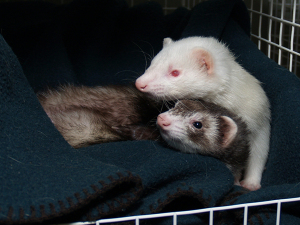
 Ferrets are
small burrowing animals, descended from European polecats. They
are often mistaken for some kind of rodent, but they are
totally unrelated, and are, in fact, a close relative of the
weasel. Ferrets can weigh anywhere from one to five pounds, with
most individuals weighing in between one and two pounds. They
are primary carnivores by nature, but as pets they happily eat a
high-protein dry food. The domestic ferret (mustela putorius
furo) does not exist in the wild, and has been a human
companion for thousands of years -- longer than the cat by some
accounts. In fact, ferrets are so adapted to being pets that
they can't survive outside on their own for more than a
few days... any dog or cat has more "street smarts." The only
wild ferret (a distant cousin to our domesticated pets) in
America is the
black-footed ferret, which unfortunately is the most
endangered mammal in North America.
Ferrets are
small burrowing animals, descended from European polecats. They
are often mistaken for some kind of rodent, but they are
totally unrelated, and are, in fact, a close relative of the
weasel. Ferrets can weigh anywhere from one to five pounds, with
most individuals weighing in between one and two pounds. They
are primary carnivores by nature, but as pets they happily eat a
high-protein dry food. The domestic ferret (mustela putorius
furo) does not exist in the wild, and has been a human
companion for thousands of years -- longer than the cat by some
accounts. In fact, ferrets are so adapted to being pets that
they can't survive outside on their own for more than a
few days... any dog or cat has more "street smarts." The only
wild ferret (a distant cousin to our domesticated pets) in
America is the
black-footed ferret, which unfortunately is the most
endangered mammal in North America.

Ferrets are inquisitive, intelligent and playful pets that live 5-7 years. They sleep most of the day, but for the 4-6 hours that they are awake, they'll explore every inch of their home and try to play with you and their cage-mates. They love cheap toys like plastic shopping bags, cardboard boxes, old socks and ping-pong balls. Toys that make noise are especially popular, as are toys that indulge their instinct to burrow, like a "dig box" full of rice or a plastic conduit to crawl through.
The ferret's curious nature can make it a challenging pet. Homes must be "ferret-proofed," so that the critters cannot get into anything that's dangerous to them. For example, the feet may have to be taken off your couch so that a ferret doesn't claw through the fabric underneath and explore the inside. Recliners cannot be used while the ferrets are at play, because the internal mechanisms could easily kill a ferret. Kitchen cabinets will need latches installed so curious fuzzies don't get under the sink and into the cleaning supplies. House plants, which can be toxic, need to be put out of reach so they are not creatively uprooted and relocated. Carpet scraps or plastic runners may need to be put under doors if your fuzzy likes to dig at the carpet there. Lastly, ferrets must be kept away from tempting chewy "treats" like styrofoam or rubbery textured items (remote buttons, soft rubber toys, etc.). Ferrets like to eat that sort of thing and small pieces may become lodged in their small intestinal tracts and cause a potentially fatal blockage.
It can be a lot of work to make a home safe for a pet ferret, so many families will only ferret-proof part of the house. When not supervised, a ferret should be confined to a 100% ferret-proofed room or put in his cage.
The ferret will adapt readily to your schedule. He will be awake and ready to play when you are, and will sleep while you are away. Ferrets are social animals and really do need your attention and should not be kept in a cage all day like a hamster! If you cannot devote some time each day to interacting with your ferrets, they aren't the right pets for you.
Most ferrets are gentle pets that are easy to handle. Like any puppy or kitten, baby ferrets (called "kits") need to be taught when they are play-biting too hard, or they'll be difficult to handle as adults. Ferrets also need to be litter-box trained, but they take to that easily since it's instinctual for them to go potty in one place.

Read or print out our brochure on ferret care. If you do not have Adobe Acrobat installed, it can be downloaded for free directly from Adobe.com.
We highly reccomend the book Ferrets for Dummies. It's really not "for dummies", and happens to be the most accurate book out there on ferret care.
For more information on ferrets, check out these sites.

| We are providing this listing as a service to help people locate ferret resources - please interview any contacts on your own. |
|
Eastside
Avian & Exotic Animal Medical Center Dr. Cathy Johnson-Delaney, DVM, DAVBP Seattle - Bird
and Exotic Clinic of Seattle Tacoma - Browns Point Veterinary Clinic Dr. Liane Sperlich, DVM
These are just a few of the great ferret sites on the web. General Information
Local Resources Organizations
Health Care
Shopping
Volunteers' Pages Other Animal Related Pages:
|